Great and Dreadful Day of the Lord
Under the Banner of HeavenThe Great and Dreadful Day of the Lord is a prophesied end-time reckoning in which Christ returns, divine judgment divides the faithful from their enemies, and a new order begins. Its significance in the book lies in the distance between a collective scriptural hope and Dan Lafferty’s personal claim to help bring that hope about: an expectation of salvation and judgment becomes, in his interpretation, a warrant for violence already committed and a forecast of violence to come.
Scriptural Promise and Lamanite Redemption
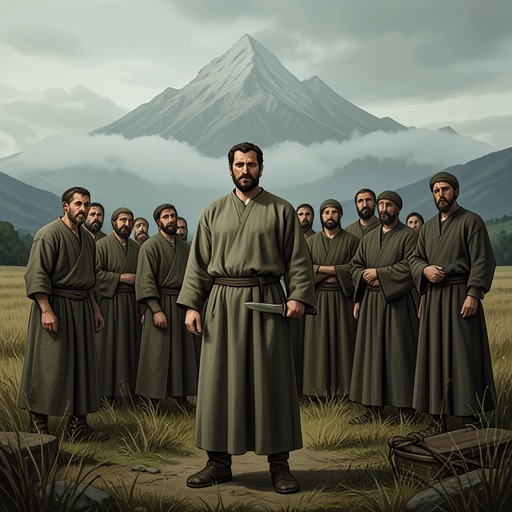
In the account of Brigham Young’s preparations to resist the United States Army, the expectation is grounded in The Book of Mormon. Its history identifies Native Americans as descendants of the Lamanites, an ancient Israelite people who rejected Jesus and fought the Nephites. The scripture describes their dark skin as a curse and foretells that they would become a white and delightsome people when Latter-day Saints converted them in the Last Days. These claims belong to the book’s presentation of Mormon scripture and its racialized religious framework; they are not neutral descriptions of Indigenous peoples.
The prophecy gives the anticipated day a political as well as a religious shape. Once redeemed, the Lamanites are prophesied to join the Mormons against the Gentiles, helping usher in the Great and Dreadful Day of the Lord. After the Saints reach the Great Salt Lake Valley, Brigham Young sees their presence among the Lamanites as evidence that this scriptural sequence is unfolding. He expects an alliance that will prepare the way for the Second Coming, but the Indigenous people described in the account do not understand themselves as the Saints’ divinely assigned allies. They may attack non-Mormons for a share of plunder, yet regard the Mormons as, at best, the lesser of two evils. Brigham’s confidence in prophecy thus contrasts with the limited, contingent cooperation he can actually obtain.
A Day of Separation and Judgment
The book also presents the Great and Dreadful Day as a harvest: Christ sends angels to remove those who do not belong to his kingdom and kill them. The phrase is therefore not simply a promise of Christ’s return. It carries the prospect of sorting, punishment, and the destruction of perceived enemies, while the same event can be understood as great for the saved and dreadful for those condemned. That division gives the prophecy its moral intensity—and leaves room for believers to claim that they know who belongs on either side.
This expectation exists alongside the historical memory of violence and demands for retribution. After the trial of the men accused of murdering Joseph Smith and Hyrum Smith ended in acquittals, Brigham Young declared that vengeance for the blood of the church’s leaders belonged to God and his people. Church authorities made an Oath of Vengeance part of the temple endowment. Participants pledged to pray continually for vengeance and to teach that obligation to their descendants through the third and fourth generations; the oath remained in the ceremony until 1927, when its disclosure provoked public and political condemnation. The oath is not the prophecy itself, but it shows how the book connects sacred expectation with lasting communal memory of injury and divine redress.
Dan Lafferty’s Personal Interpretation
Dan Lafferty casts the promised harvest as the removal of people he identifies as children of the devil, clearing the way for a thousand-year reign of the Kingdom of God. He interprets the prophecy’s angels not as heavenly beings but as avenging men already living on earth, acting for God once they have been instructed about their true father. This reading turns a future divine judgment into a task that human agents might begin in advance.
Dan explicitly places the murders of Brenda and Erica within that interpretation, saying he had foreshadowed the harvest by taking their lives. The book reports this as Dan’s explanation, not as an established divine purpose or a religiously accepted interpretation. His claim makes the prophecy a retrospective justification for the murders and, at the same time, a script for future action. The distinction matters: the prophecy’s language supplies Dan with a framework, but the book identifies his application of it as his own.
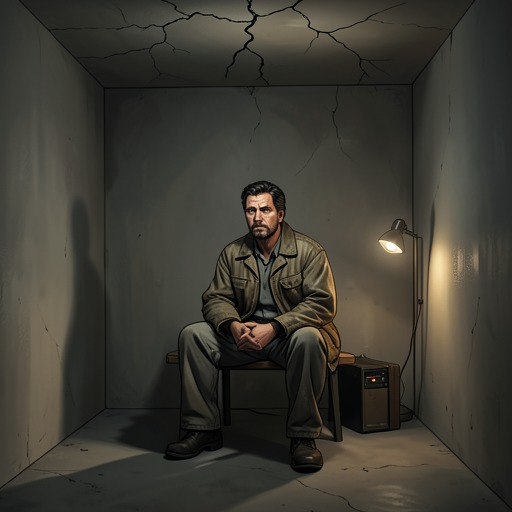
Dan also believes that God has designated him as Elijah, responsible for telling the righteous who their father is and helping initiate Christ’s thousand-year reign. A year or two after his incarceration, while pacing in his cell in the middle of the day, he says he heard a voice give him a sign: the moon would shine from noon until nine. He later decided this meant that the moon’s daytime appearance would announce Christ’s return. The detail gives his expectation a concrete, observable test, even though he admits he does not know how such a sign would occur.
Competing Claims and Consequences
Dan uses his private prophetic system to explain a later conflict with his brother Ron Lafferty as well. He surmises that Ron tried to strangle him in 1984 because the devil had already disclosed Dan’s supposed Elijah assignment to Ron, before God revealed it to Dan himself. This is Dan’s speculation, not confirmation that Ron received such a revelation. The episode shows how the prophecy expands within Dan’s reasoning: it accounts not only for the future harvest and the murders but also for another person’s past actions.
Across these accounts, the Great and Dreadful Day moves between scripture, communal expectation, and individual certainty. Brigham Young reads the anticipated alliance with the Lamanites as fulfillment of prophecy; the Saints’ temple oath sustains a collective demand for vengeance after Joseph Smith’s death; Dan makes himself an agent of a judgment he believes is approaching. The book’s contrast is not simply between belief and disbelief. It is between a prophecy held within shared religious history and a private interpretation that appoints its interpreter to decide who must be removed. For Dan, the promised future becomes both an explanation of past violence and a sign-filled expectation of Christ’s return.